
[juicebox gallery_id=”257″]
On May 28, 2015—following a four day camp in the Weminuche Wilderness, a highly technical climb, exciting descent of 13,824-foot Jagged Mountain and brutal exit through the forest—Chris Davenport, Ted Mahon and Christy Mahon cracked open some Ska Brewing Company beers. They had done it. The trio became the first humans to summit and ski the 100 highest peaks in Colorado, completing their Centennial Peaks Project .
The Centennial Peaks Project has been ongoing—and well documented, thanks to the group’s regularly updated blog —since April of 2013. However, when you incorporate skiing the fourteeners (Colorado’s 53 14,000-plus foot peaks) the three have been on this journey for almost a decade. Davenport was the first to ski the fourteeners in one calendar year back in 2007 , Ted Mahon became the third to ski all of them in 2008 and Christy Mahon was the first woman to ski the lot of them in 2010. It was only natural that the three Aspen, CO-locals would team up to complete the final 47 mountains that make up the state’s Centennial Peaks. However, it also made the logistics of the project a bit more difficult.
“The three of us went through the fourteeners on our own schedules, and that was a little more personal,” explains Ted Mahon. “We got together to do this as a group and then it got more complicated. You’re suddenly three people with real life schedules, and in Chris’ case, he has three kids. So you’re just trying to plan around that, as opposed to just going at it when you’re free. It just takes more planning than people would realize.”
Planning these outings amidst busy schedules—Davenport’s career as a pro skier while raising three children, Christy Mahon’s nine-to-five job as the Development Director for the Aspen Center for Environmental Studies and Ted Mahon’s post as a freelance photographer and web designer—wasn’t simple. In addition to blocking off time for completion, the crew had to gather intel on the weather and fickle Colorado snowpack, plan out routes and then, of course, put those itineraries into action.
“For all of us to pull together our schedules, our health, our fitness, our planning and support for this project, I don’t think people realize how complex the behind-the-scenes logistics for these endeavors are,” says Davenport.
Preparing for the Centennial Peaks presented more of a challenge than tackling the fourteeners. Information regarding established routes and trails for Colorado’s fourteen thousand foot peaks have been well documented via guide books, trip reports and more. The 47 highest thirteen thousand foot peaks are a different story.
“With the fourteeneers, you really are following what others had already done,” says Christy Mahon. “I really loved the old fashioned aspect of getting out [and studying] the map for this project. For Stewart Peak, we tried both ways to approach it, from the North and from the South, because we didn’t know what was the best way. We’re still not really sure, but that part was what made the whole experience so cool for us. Being the first three people to have done it.”
For Stewart Peak (13,983 feet) the crew endured a 35-mile roundtrip on bikes, skins and foot. 13,972-foot Pigeon Peak and 13,835-foot Turret Peak required a multi-day trip that involved a ride on the Durango-Silverton Narrow Gauge Railroad in addition to trail-less route finding. And that’s just two examples.
Stewart Peak wasn’t an easy one.
In that sense, the threesome are pioneers in the true meaning of the word. In the same fashion that Lewis and Clark set forth to explore the western United States in 1804, Davenport and the Mahons journeyed into uncharted territory. Sure, the Centennials had been climbed in their entirety before—Ted and Christy themselves had completed that feat already—but no one had struggled to each mountain top, strapped on a pair of planks and carved turns to the bottom.
In addition to the intense time commitment and planning, for the project to be dubbed a success, there was a certain air of survival surrounding it. Forty-seven daunting and dangerous peaks later, and the crew are all still here, in tact.
“I am grateful to still be here,” explains Davenport. “But that didn’t come from luck or good fortune. It came from years of educating myself and surrounding myself with good partners. That’s where the ability to make good decisions comes from.”
A solid group dynamic was necessary for this project to be successful. It took all of the team members’ diverse skill sets and points of view to ensure intelligent group decision making as well as morale boosts.
“It shows that you don’t necessarily need to be exactly the same people to be successful in the mountains,” explains Christy Mahon. “My point of view might be a beneficial one, because I’m thinking about things more conservatively than, say, Dav. Having women on the team adds a different dynamic. It’s really good to have the woman’s perspective out there and that was always very much respected and appreciated within our team. I wasn’t ever afraid to say ‘I don’t know if I’m comfortable with that.’ In the end we always found the right way.”
And it was at the end of the project that the group dynamics were tested the most. By mid-May 2015, Davenport and the Mahons skied 43 of the 47 Centennial Peaks, but it was the final four that presented the biggest challenges, specifically Pigeon Peak, Turret Peak and Jagged Mountain. In May of 2014, the trio—along with photographer Ian Fohrman—set out into Colorado’s Weminuche Wilderness, the biggest wilderness area in the state, to try and tackle five Centennial Peaks.
“We had this bold idea of skiing all five in one big traverse,” explains Ted. “We went in last year and immediately learned on the first day that we weren’t going to be able to do that.”
The group came away with two ski descents, backing away from two due to weather and one, Jagged Mountain, because of sheer difficulty. That left Pigeon Peak, Turret Peak and the aforementioned 13,824-foot Jagged to be skied in the zone. It was only fitting that these peaks stood as the final threshold to which the crew would cross through. Ted Mahon referred to it as a microcosm of the project as a whole.
“The peaks down in that range defined the whole project. There were five in there that ultimately took four trips to get them all done,” he explains. “The crux of [the whole project], for us, became these five peaks. I think that’s the way some of these projects can be, a lot of it can happen pretty easily and smoothly and then it ends up resting on one or two peaks.”
More often than not, with projects such as this, the difficult objectives get pushed in favor of easier (relatively speaking) ones, whether due to time constraints, convenience or other circumstances. As a result, according to Ted Mahon, “suddenly you’re backed into a corner where you don’t have any choice [but to ski them].”
That’s where they found themselves, staring down the belly of the beast, the Weminuche, with three peaks left to tackle. On May 6, the crew ventured in for a multi-day trip, returning with peaks number 98 and 99 checked off, Pigeon and Turret. And with the exception of a pesky wet slab on Pigeon, the trip went without a hitch.
That left Jagged, the final piece of the puzzle.
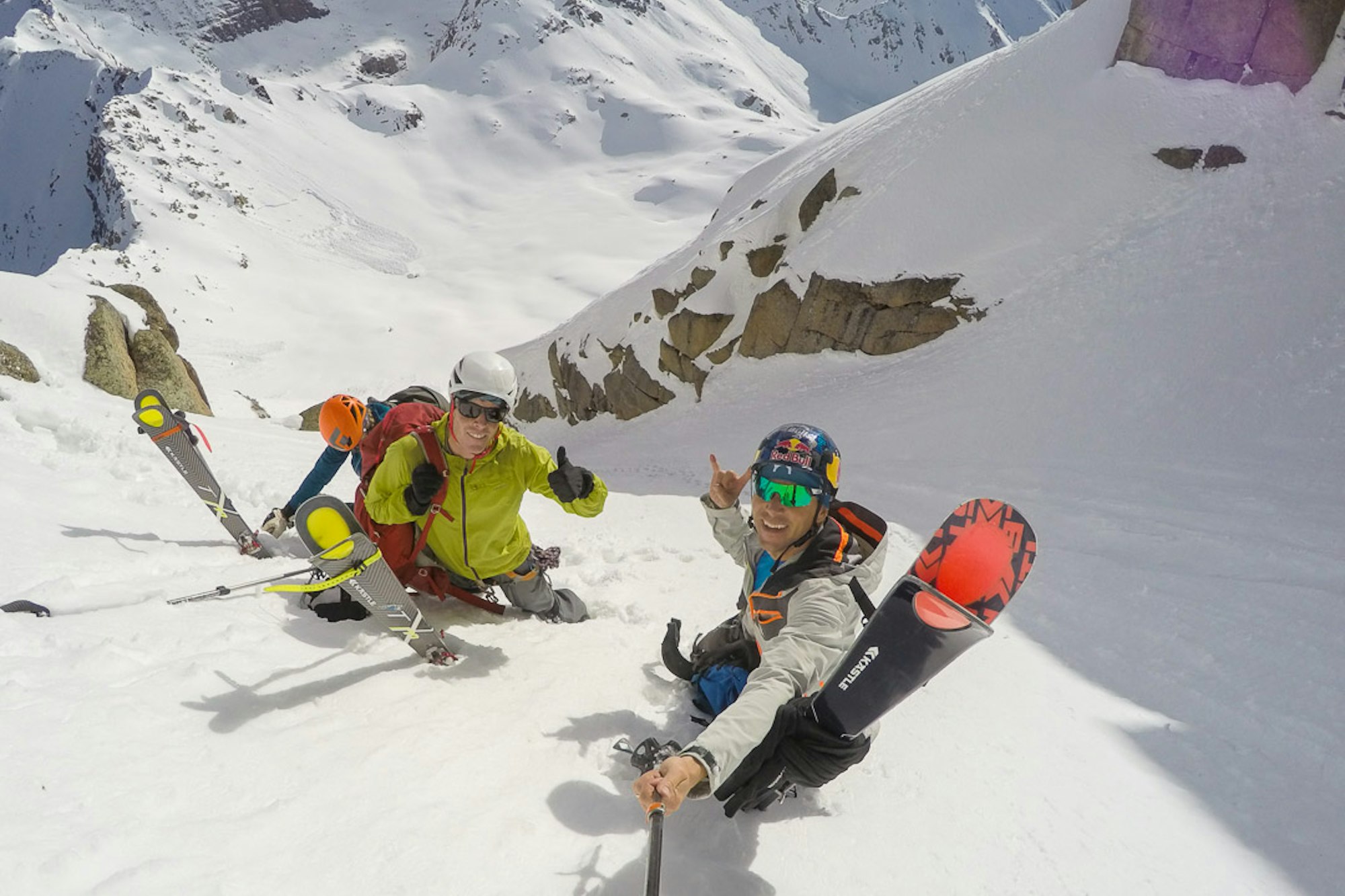
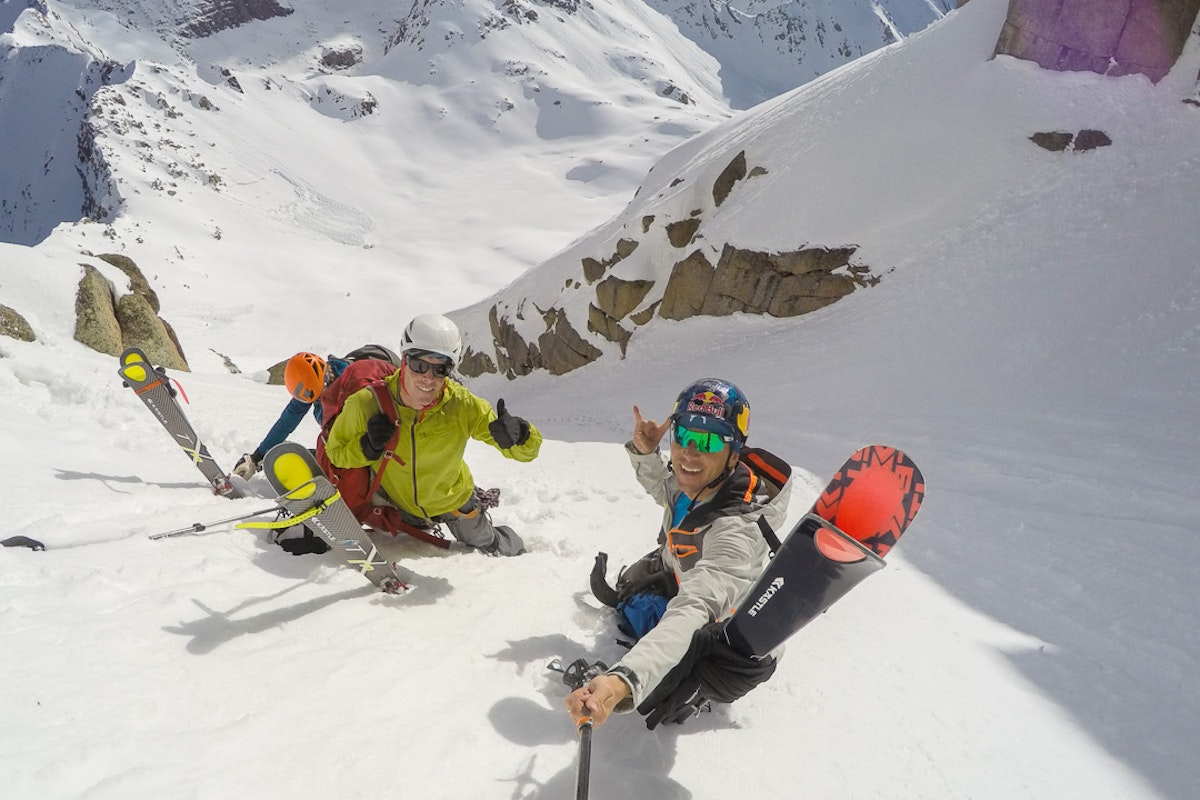
Each of the members of the team (Strafe Outerwear co-founder Pete Gaston joined along on the Jagged objective) harped on the fact that Jagged needed every ski mountaineering skill they had to be employed.
The Jagged Mountain route, beginning from left to right.
“It just presented every challenge that you could encounter,” said Ted. “We didn’t have any ski history on it and it’s not something that skiers would look at as an aesthetic ski. We didn’t even know how to approach, there were questions of coming in from the East or one of the multiple ways from the West. How much gear do we need? What do we do about the fact that there’s no proven ski line on it?”
“All of our ski mountaineering skills learned in Colorado and throughout the world were brought to bare on Jagged Peak,” said Davenport. “It really required everything we had and was really awesome. We think it was a first descent, we’re not really publicly claiming that because, who knows, there might have been some hippy in the 70s that was there on acid and skied it, but I highly, highly doubt it.”
In the end, the final slog required three nights of camping and the longest approach of any of the other peaks, one that includes a train ride from Silverton into the wilderness. The group had to ascend the über steep couloir, stash their skis, complete the technical climb to the summit and rappel back down to their skis. All before even making one turn.
Following another night at low camp, the group made their way back to the train, cracked open those Ska Brewing beers and began a light celebration.
Descending Jagged Mountain.
For those following the project, the obvious question for Davenport and the Mahons is, “what’s next?”
Davenport, reflecting on an already brilliant career, will focus his efforts on his business ventures that include Kastle Skis and Spyder, while furthering efforts to promote education through the American Institute for Avalanche Research and Education ( AIARE ).
But, he deflects the notion of slowing down. “I don’t know about slowing down, I’m not even sure what that would look like. I’m still going to keep going at everything full gas, even if it’s not full gas in the mountains, it’s full gas in the industry,” he says. “I’ll continue to be a positive influence in the sport of skiing anyway that I can.”
For the Mahons, the end of this project is bittersweet. “I did feel a bit of sadness, in a way, of it being over,” explains Christy. “I don’t think we’ll ever be able to relive that in the same way.”
“There is a natural sense of ‘what now?'” explains Ted. “It feels a little empty, you know? Because when you put a lot of energy into that stuff, you get used to it.”
Rest assured, however, there’s always another project. “We were even looking at the Bicentennials and there’s definitely some super exciting ones we want to ski,” says Christy. “We were laughing at how it could be a retirement project, still out doing it when we’re 60.”
Aside from what’s next for each of the team members, the Centennial Peaks Project can still serve aspiring ski mountaineers the country and world over. There’s now intel on how to access and ski these 47 subliminal peaks, something that wasn’t previously available.
And for those aspiring to achieve feats like this, Davenport provides words of wisdom: “I spent a lot of time in my twenties and thirties getting educated, taking courses, paying my dues, getting out there with good people and learning about how to make good decisions in the mountains. I firmly believe that’s one of the reasons I’m still here today. You could still make mistakes out there, but there is no substitute for getting your hands dirty in the mountains, digging in the snow, educating yourself and having good mentors. It’s not only necessary, it’s mandatory.”
At this point in his career, the Centennial Peaks Project could be considered Davenport’s magnum opus, his greatest work. He called it “probably one of, if not my biggest accomplishment to date.” And it’s only natural that the man is reflective. “When I’m 85 years old, still skiing Snowmass and looking back on things, whether it be my adventures in Colorado or around the world, the big takeaway is the fact that I’m still here, I’m still alive,” he says. “To still be here, that means a lot, and to think about all of our lost friends, it makes me all the more respectful.”
For more on the project, visit centennialskiers.com .
![[GIVEAWAY] Win a Full 26-27 Ski Setup from Fischer](https://www.datocms-assets.com/163516/1790101711-00012060-edited.jpeg?w=200&h=200&fit=crop)